
Every enquiry leaves a trace. A name, a phone number, the model someone was looking for. Over the years that grows into a valuable asset. So it is worth asking who actually owns it. A dealer who owns their customer data keeps a direct line to the buyer. A dealer who only rents it loses that line the moment the listing portal invoice runs out.
Many businesses notice this far too late. The enquiries come through a large listing portal, the contacts live there, and someone else writes the rules. This article shows why that is a risk. And it shows how the ADP Car Market Hub WordPress plugin by AD Promotion collects every enquiry in your own system.
Why your customer data is your most valuable asset
A dealership sells vehicles, but it lives on relationships. Today’s buyer is tomorrow’s referral and the repeat customer four years from now. That relationship sits inside the data. In the note about which model someone was after. In the reminder of when the next service is due.
Such details are not decoration. They are the foundation for every later conversation. A dealer who knows that a family bought a station wagon three years ago can offer the right successor at the right time. Without that data, every contact starts again from zero.
Here is an everyday example. A salesperson looks after the same regular customers for years. He knows who drives a diesel and who prefers to lease. If that salesperson leaves and his knowledge was never written down, it walks out the door with him. Stored cleanly in your own system, it stays with the business. It is precisely this saved history that makes customer data so valuable.
How listing portals rent you access to your own buyers
A large listing portal brings reach, and no one disputes that. The real price, though, rarely appears in the contract. A prospect’s enquiry reaches you through the marketplace inbox. The first contact happens on someone else’s ground.
That has consequences. You see a name and perhaps a short message. The full history, the search behavior and the background stay with the operator. You are renting access to your own buyer, month after month. When the subscription ends, so does the link to those contacts.
Picture a rental car. As long as the invoice is paid, it sits in front of the door. Stop paying and it is gone, and not a single mile belongs to you. Rented contacts work the same way. You pay for closeness that can end at any time.
How your customer data stays with you
The ADP Car Market Hub WordPress plugin receives every enquiry directly on your own website. The name, the message and the requested vehicle land in your own WordPress, not in the inbox of an outside service. You see the full history, you can export it, and you keep control of every contact. So the buyer belongs to your business, not to the listing platform.

What rented customer data really costs you
The monthly fee is only the visible part. The dependence that builds over time costs more. A dealer who sources every contact through a single listing portal can barely negotiate its prices. When the fee rises, the only options are to pay or to leave.
On top of that comes a quiet loss. Every prospect who only appears on the marketplace is missing from your own records. You build reach over years, and someone else keeps its value. The day you cancel, the work starts over from the beginning.
One dealer once described exactly that moment. After switching providers, thousands of collected enquiries were no longer reachable. The addresses sat in the old account and access was gone. What looked like a large customer base turned out to be borrowed.
How your own website keeps the data in your hands
The way out is not an expensive extra program. It is your own website as the hub. When a prospect submits an enquiry there, the contact belongs to you at once. No detour, no outside inbox, no monthly rent just for access.
Technically this is straightforward today. The ADP Car Market Hub WordPress plugin builds every vehicle as its own page and guides the prospect to the contact form. The enquiry lands in your WordPress, neatly tied to the vehicle. From that grows a base that genuinely belongs to you.
For the wider picture of becoming less dependent on the big providers, read here, how a dealership becomes independent of listing portals. Owning the data is the first step.
From real use
For years a dealership received its enquiries almost entirely through a large listing portal. The contacts lived on the listing site, not in the business itself. Then the dealer used the ADP Car Market Hub WordPress plugin to set up its own vehicle pages, each with its own contact form. Since then every enquiry arrives directly in the dealer’s own WordPress, complete and tied to the vehicle. Over the months that grew into a base of contacts the business owns itself. The plugin made the difference, because only the dealer’s own pages, found through Google, brought the enquiries into the dealer’s own system. It is not a promise of numbers, but the lever is clear.
Owning the data also means clean data protection
Owning customer data means carrying responsibility for it too. That sounds like a burden, but it is an advantage. With the data in your own system, you know exactly what is stored and who can reach it. With an outside marketplace, you simply have to trust.
Data protection rules call for access, deletion and a clear purpose. All of that is easier when the data sits in one place you control. When a customer asks what you hold about them, you find the answer in your own back end, without bringing in a service provider.
For the buyer, trust grows from this. People hand their number more readily to a business that says openly what it is for. A short, honest note on the form does more than any seal. Data ownership is therefore not only technical. It is seriousness made visible.
Back up your contacts regularly
Export the collected enquiries from your WordPress at fixed intervals and keep a copy off the server. That way the most valuable part of your business survives even if the technology fails once. A dealer who owns the contacts should also protect them.
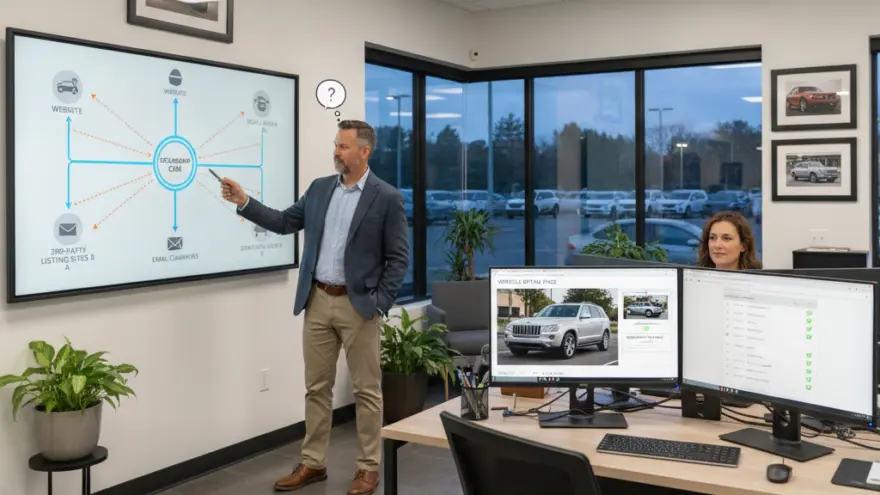
How to start owning your customer data
The first step is an honest inventory. Where do your contacts live today. How many of them can you reach only through an outside listing site. That single question often shows how far the dependence has grown.
Next comes building your own point of contact. Every vehicle gets its own page with its own contact route. From now on enquiries arrive with you first. The marketplace stays one channel among several, not the only one.
Finally, you use what you collect. A well kept base allows the right approach at the right time. For turning these contacts into reliable enquiries, read here, how a dealership wins leads digitally. This is how borrowed reach becomes an asset of your own.
Conclusion
Customer data is the quiet capital of every dealership. It decides whether a sale turns into a lasting relationship. Held on an outside listing portal, you rent access to your own buyers and lose it the moment you stop paying. Held on your own website, it belongs to your business. The ADP Car Market Hub WordPress plugin by AD Promotion receives every enquiry directly with you and ties it to the vehicle. Over time that builds a base of customers no one can cancel. A dealer who owns their customer data keeps the future of the business in their own hands.
Sources
- GDPR-Info, full text of the General Data Protection Regulation.
- Information Commissioner’s Office, guidance on handling personal data for organizations.
- Federal Trade Commission, privacy and data security guidance for businesses.
- Think with Google, research on how buyers search and decide online.
Frequently Asked Questions
Who owns the enquiries that come through a listing portal?
You receive the enquiry, but the full contact and history live in the portal’s system. You have access only while your contract runs. Real customer data begins when the enquiry reaches your own system through your own website.
What happens to my contacts when I cancel the contract?
With portal-only use you often lose access to the collected history. Names and conversations stay in the outside account. When the enquiries run through your website instead, the data stays in your WordPress and therefore in your business.
Do I need an expensive CRM to own my customer data?
Not necessarily. To start, it is enough that enquiries arrive cleanly in your own system and are tied to the vehicle. The ADP Car Market Hub WordPress plugin handles that directly in WordPress. A large extra system only pays off at very high volume.
How do the enquiries reach my own system?
Every vehicle gets its own page with its own contact form. When a prospect fills it in, the plugin stores the enquiry in WordPress with the vehicle, the contact details and the time. If you wish, you also receive an email notification.
Is storing my own customer data compliant with data protection rules?
Yes, as long as you follow the usual rules. That means a clear purpose, an understandable privacy notice and sensible retention periods. With the data in your own system, access and deletion are actually easier than with an outside service.
Should I give up listing portals altogether now?
No. A listing portal remains a useful channel for reach. The point is simply not to make it the only route. When every enquiry arrives on your own page first, you use the reach and still keep the data.
How do I protect the data I collect?
Keep WordPress and the plugin up to date, grant only the access that is needed, and back the enquiries up regularly to a copy off the server. That way the valuable base of contacts survives even a technical failure.
What is the best way to start?
First check where your contacts live today and how many you can reach only in a portal. Then set up your own vehicle pages with their own contact route, so enquiries arrive with you first. That single step shifts data ownership back to your business.