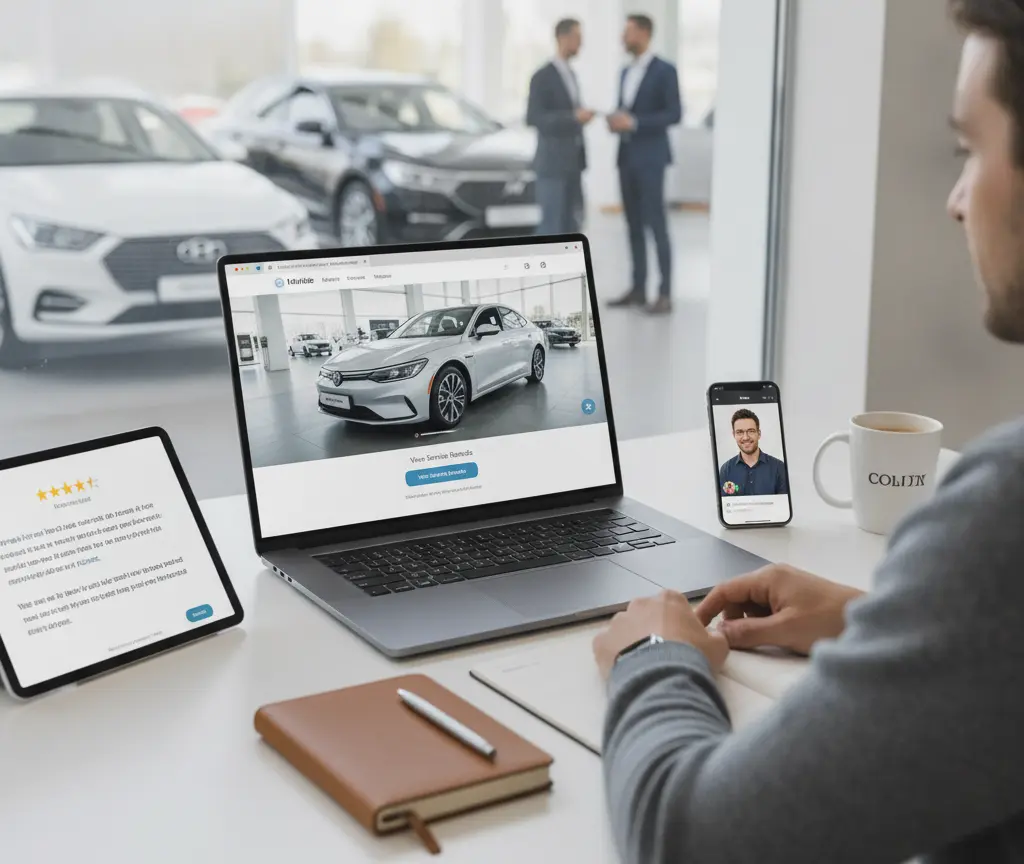
A buyer makes up their mind long before they reach your lot. On the screen they decide whether your offer looks credible and whether the drive over for a test drive is worth it. A dealership that earns online trust often wins the appointment before the phone ever rings. The ADP Car Market Hub WordPress Plugin from AD Promotion lays that groundwork by turning every vehicle into its own believable page.
Many dealers know the pattern. The car is clean, the price is fair, and still the enquiry never comes. Often the car is not the problem; what is missing is a reason to trust the seller before the visit. This article shows what that impression rests on and how you build it on your own website, step by step.
Why the decision happens before the test drive
The path to a used car begins on a screen, not on the lot. In the evening a buyer compares several listings, drops the ones that look dubious, and keeps two or three dealers worth contacting. Make that shortlist and you get the enquiry; miss it and the buyer never looks your way again.
This pre-selection takes only minutes, and the buyer makes it alone. Here is an everyday example. A family looks for a station wagon under twenty thousand dollars, finds three suitable cars, and opens the one whose page shows full photos, a clear history, and a named contact first. The other two stay open in the browser but rarely get a second look. The first impression of the page decides the matter long before anyone turns a key. You can read how much that first moment matters here, why the first impression decides the car purchase.
What builds online trust on the vehicle page
Trust does not come from a single sentence; it adds up from many small proofs. On a vehicle page, full photos from every angle, an honest description, a complete history, and a price that makes sense all carry weight. Leave one of them out and the buyer grows cautious and clicks on.
What matters most is openness, especially about a car’s weak points. A dealer who shows a small paint chip with a photo looks more credible than one who shows only gloss. That is how you build online trust, because the buyer senses there will be no nasty surprises in person. A family that sees an honestly documented car arrives at the test drive far more relaxed than someone who spots the first scratch only on the lot.
What a trustworthy vehicle page looks like
The ADP Car Market Hub WordPress Plugin turns your vehicle data into full detail pages with a gallery, equipment, price, location, and a direct contact. Every detail sits clearly in one place, so the buyer finds everything the decision needs. A reliable impression of your business forms before the first call.

Real faces and reviews instead of anonymous listings
On a third party marketplace every dealer looks the same, a single row in a long list. The buyer sees a car but not the people behind it. On your own page you flip that around and show your team, your address, and the story of your business.
Real customer reviews convince most when they sit right where the buyer is weighing things up. If someone reads next to the car that an earlier handover went smoothly, their uncertainty drops and online trust grows. A local dealer with a name and a face feels more approachable than an anonymous listing among hundreds. You can read how to place reviews exactly where they count here, how to show real reviews where buyers decide.
A second point is the personal tone. Write who looks after the car and who picks up the phone. Give a name, not a faceless form. Show a photo of your premises, not just a logo. The buyer then senses a real business behind the offer. That lowers the hurdle to make the first move.
Clear prices take away the uncertainty
Little puts buyers off online like a missing price. A price on request forces a step many avoid, and it sends them to the next listing that shows a real number. A visible price signals instead that you have nothing to hide.
A short bit of context adds even more confidence. List the key facts next to the price, such as first registration, mileage, and the number of previous owners, and the buyer immediately understands why the car costs what it costs. A rough monthly figure builds online trust too, since many buyers think in installments. A bare number becomes an offer that makes sense.
Show every price openly
Look at your vehicle pages once through a stranger’s eyes. Does every car have a clear price, a mileage figure, and a named contact? Wherever one of those is missing, a small doubt forms that often sends the buyer clicking to the next dealer.
Quick answers and an easy path to the test drive
Trust only holds if the next step is easy. If the buyer finds no clear way to make contact, or waits two days for a reply, the good first impression falls apart again. A quick, friendly response confirms the online trust the page first earned.
A direct path to the test drive helps, ideally as a simple request next to the car. A buyer who can name a preferred time at ten in the evening feels taken seriously and stays with you. Here is an example. Someone sends a short booking request on Sunday and gets a personal confirmation with a name on Monday morning. That reliability is what separates a business people trust from one that merely offers a car.
Keep the path short. A clear call button belongs on every vehicle page. A brief form next to it catches those who would rather write. People who prefer to talk simply call. What counts is that no question is left open.

What the ADP Car Market Hub WordPress Plugin handles here
The ADP Car Market Hub WordPress Plugin turns your vehicle data into your own complete pages on your WordPress website. Each car gets a detail page with a gallery, equipment, price, location, and a direct contact, and you can add reviews and a path to the test drive. You can pull the inventory from AutoScout24, a spreadsheet, a feed, or by hand, without keeping it twice.
What matters is that every page belongs to your own domain and does not sit inside a foreign embed. That way each car builds trust for your business, not for someone else’s marketplace. You can read how a website visitor turns into a visit at your dealership here, how to turn website visitors into a showroom visit.
From real use
A dealership put its cars online as its own detail pages with the ADP Car Market Hub WordPress Plugin, with honest photos, a clear history, and a visible contact. Many buyers then arrived already informed and ready for the test drive, because the open pages were found on Google and had built online trust in advance. The plugin made the difference, since only the dealer’s own findable pages made that impression possible. It is no guarantee, but the link is easy to see.
Conclusion
Anyone buying a used car spends a lot of money and wants to feel sure beforehand. That confidence does not start on the lot; it starts online, long before the first test drive. Full photos, an honest description, clear prices, real reviews, and an easy way to make contact build exactly this online trust. The ADP Car Market Hub WordPress Plugin from AD Promotion brings your cars onto your domain as their own credible pages, so the buyer arrives at the test drive already convinced. You gain not only visibility but the trust that decides the sale in the end.
Start small. Pick a dozen cars and give them full, honest pages. Then watch how many enquiries follow. The effort usually pays off fast. Trust grows long before the customer pulls onto your lot.
Sources
- Cox Automotive, research on the car buyer journey and online behavior.
- AutoScout24, vehicle marketplace for new and used cars in Europe.
- Google Search Central, how Google Search finds and indexes content.
Frequently Asked Questions
When does a buyer decide whether to trust a dealer?
Usually online, before any call or visit. On the vehicle page the buyer checks photos, description, price, and contact, then decides within minutes whether a visit is worth it. An open, complete page earns trust before the first conversation begins.
What belongs on a trustworthy vehicle page?
Full photos from every angle, an honest description, the history with first registration, mileage, and previous owners, a clear price, and a reachable contact. The less a buyer has to ask, the sooner they get in touch.
Should I show small defects openly?
Yes. A named paint chip with a photo looks more credible than gloss alone. A used car buyer expects some wear and values the honesty. You avoid disappointment in person, and the test drive starts on a calmer footing.
How important are reviews for trust?
Very, especially right next to the car. When a prospect reads that earlier handovers went smoothly, their uncertainty drops sharply. Real reviews with a name carry more weight than general marketing claims.
Why does price on request put buyers off?
Because it demands an extra step many avoid. Most buyers prefer to click to the next listing with a real number. A visible price saves the prospect effort and shows that you price openly.
How fast should I answer an enquiry?
As fast as you can, ideally the same or the next day. A late reply undoes the good first impression of the page. A short, personal response with a name confirms to the buyer that they have come to the right place.
Do I strictly need AutoScout24?
No. AutoScout24 is a convenient data source, not a condition. You can load the inventory just as well from a spreadsheet such as CSV or Excel, through a feed, or by hand. The ADP Car Market Hub WordPress Plugin builds your own vehicle pages from it.
How is this different from a marketplace listing?
On a marketplace your business is one row among many. On your own page you show your team, location, and story and tie the car to real trust. That page belongs to your domain and keeps working for you over time.